
Understanding funding
at Alliance College-Ready Public Schools
Transparent Insights into How Public Funding Supports Our Schools
Welcome to our dedicated page, designed to shed light on the financial underpinnings of Alliance College-Ready Public Schools, including all 26 campuses. This page offers a detailed look at how public funding supports the pivotal work at our schools and the efficient management of resources that sustains our mission.


1,400+ educators and professionals committed to equity and scholar success
★
1,400+ educators and professionals committed to equity and scholar success ★
Transparent insights into how public funding supports our schools

Alliance College-Ready Public Schools Funding Explained
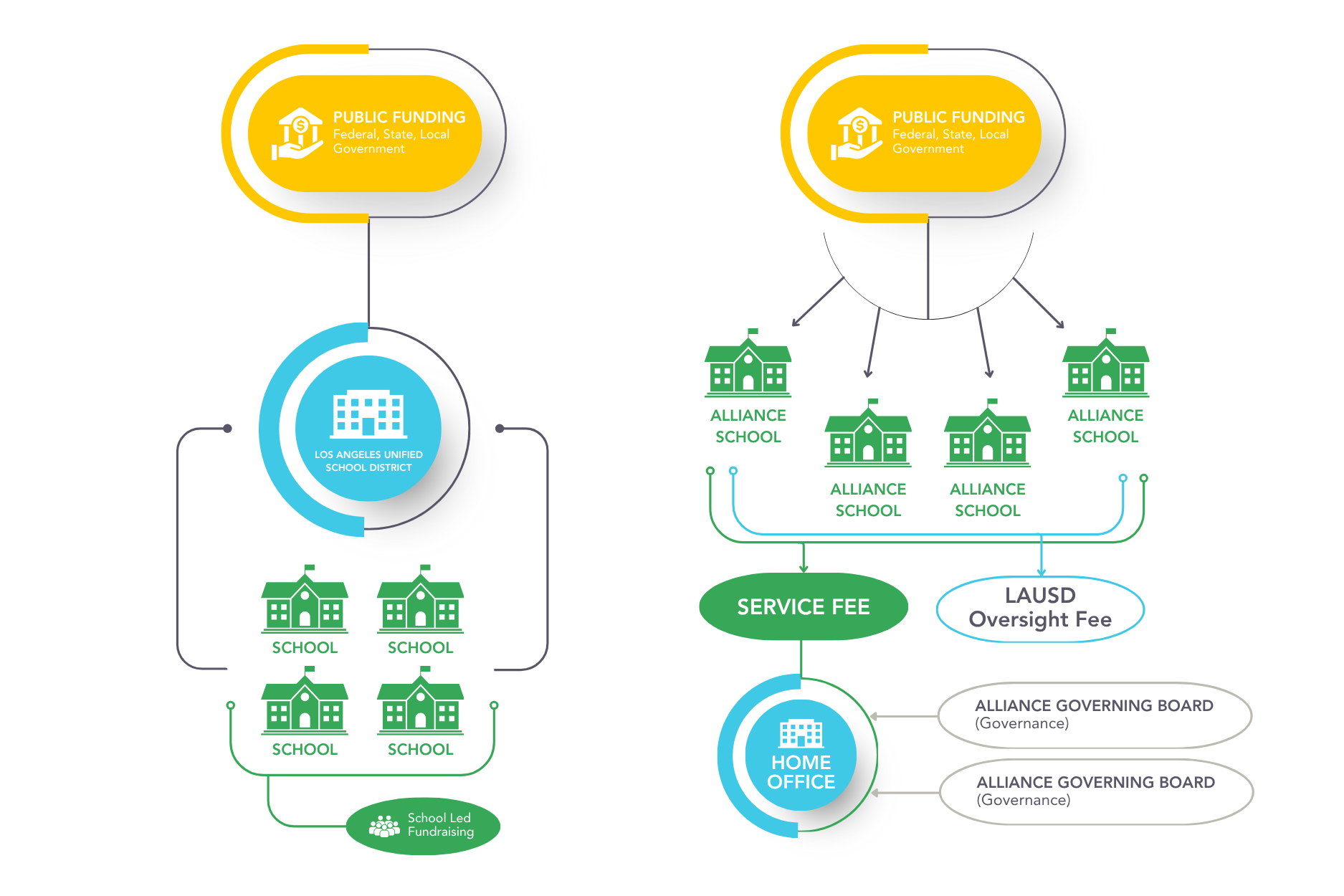
All 25 of Alliance’s schools receive their funding directly from the state government, ensuring transparency and clarity in the management and allocation of resources.
Public Funding Sources: Alliance schools are primarily funded through federal, state, and local government contributions. These funds are directly channeled to individual schools to immediately benefit our scholars and staff.
Service Fee to Home Office: A modest portion of the funding is allocated as a service fee to the Alliance Home Office. This fee supports crucial operational supports, including teacher professional development, scholar instructional resources, campus safety measures, scholar enrollment, etc. Alliance’s Home Office is only X% of our network’s total budget. At LAUSD, for example, the district office accounts for XX% of their total budget.
LAUSD Oversight Fee: A small percentage of the funding is also set aside for the LAUSD oversight fee, a mandatory procedure for all public charter schools in the district to ensure compliance and accountability. It is worth noting that LAUSD’s district office doesn’t offer the same level of oversight for its own schools.

Traditional Public School Funding Explained
Unlike the Alliance network that receives funding directly, traditional public schools operate under a different financial model:
Direct Government Funding to Districts: Traditional public schools receive their primary funding from federal, state, and local governments. However, these funds are not sent directly to individual schools. Instead, they go to the central school district (e.g. LAUSD).
Allocation Process: Once the government funding is received, the school district is responsible for distributing these resources among its network of schools.
Factors Influencing Distribution: The distribution of funds by the district may be influenced by various factors including school size, needs, student demographics, and specific program requirements.
Understanding funding and resource prioritization at Alliance Schools
Understanding the direct funding structure for Alliance schools is crucial for appreciating the inherent trade-offs involved in resource management. All schools – whether traditional and charter public – operate with a limited budget, which necessitates careful prioritization of resources to align with the district’s core mission. At Alliance, this strategic approach to budgeting ensures that every dollar is spent in a manner that maximizes its impact on scholar success, contributing directly to our impressive achievement: 95% of our scholars graduate from high school, and 96% of our graduates are accepted to college. These successes stand in stark contrast to the fact that XX% of our students come to Alliance, typically from an LAUSD neighborhood school, more than 3 grade levels behind.